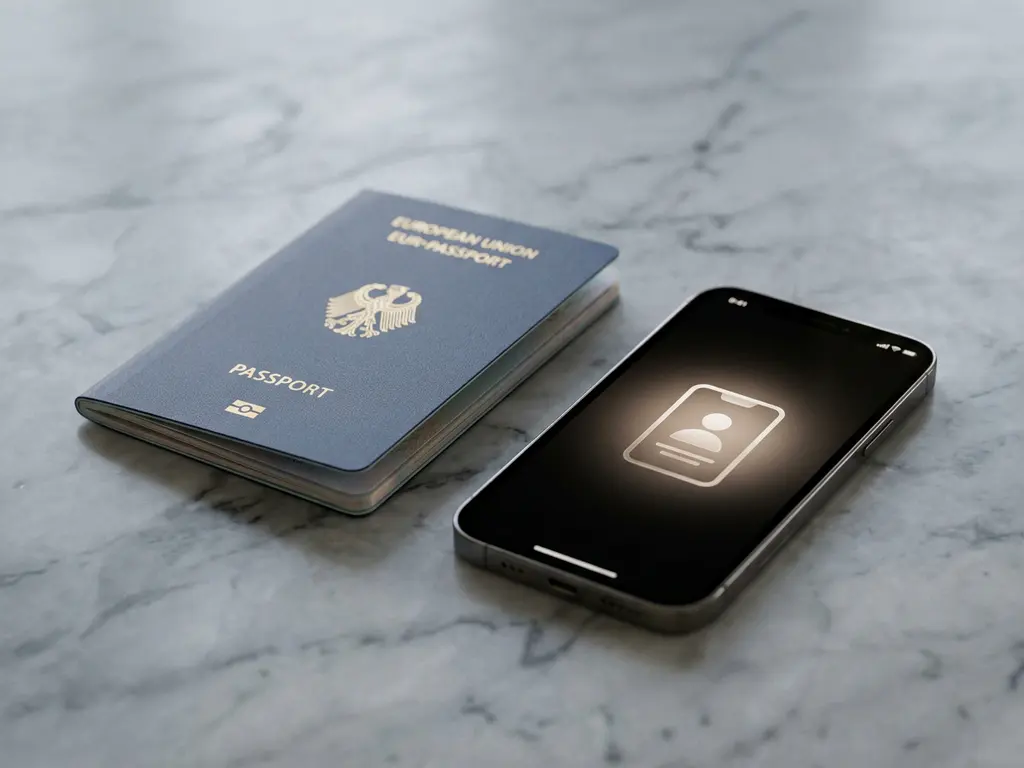
The EUDI Wallet and a national eID are both tools for digital identity, but they serve different purposes. A national eID is a government-issued credential that proves who you are, typically within one country. The EUDI Wallet is a broader digital container that can hold your national eID alongside many other verified credentials, and it works across all EU member states. The sections below explain the key differences in how they work, what they store, and who controls your data.
How does the EUDI Wallet work differently from a national eID?
A national eID is a single credential issued by your government to confirm your identity, usually for use within that country’s public and private services. The EUDI Wallet is a mobile application that acts as a personal digital container, holding multiple verified credentials, including your national eID, and presenting them securely to services across Europe. The wallet operates within the eIDAS 2.0 framework, which is established by Regulation (EU) 2024/1183 amending Regulation (EU) 910/2014. The legally binding requirements are contained in the implementing acts adopted by the European Commission, while the Architecture and Reference Framework provides the technical elaboration of those requirements.
The practical difference comes down to scope and flexibility. Your national eID typically connects to a fixed infrastructure managed by your government. When you use it, you often authenticate through a national portal or app, and the relying party receives a predefined set of identity data. The EUDI Wallet lets you selectively disclose specific attributes from any of your stored credentials. You share only what is needed for the specific transaction.
Another key difference is the underlying architecture. The EUDI Wallet stores credentials on your device in standardized formats, specifically mdoc and SD-JWT VC, and uses cryptographic proofs to verify the authenticity of what you share. Verifying a presentation involves three distinct checks: the issuer’s signature is verified against the relevant national trusted lists, which are brought together in the EU List of Trusted Lists; the revocation status of the credential is checked via the issuer’s status information; and the wallet unit attestation is checked to confirm that the presenting wallet is running on a certified wallet solution. Only the first of these checks can be performed fully offline, so describing wallet-based verification as entirely independent of any online contact is not accurate in all scenarios.
What types of credentials can the EUDI Wallet hold?
The EUDI Wallet can hold a wide range of government-issued and institutional credentials. This includes your national eID, mobile driving license, educational diplomas, professional qualifications, European Health Insurance Cards, and travel documents. Any organization authorized as a trusted issuer under the eIDAS 2.0 framework can add credentials to your wallet. Credentials take the form of attestations, which may be qualified electronic attribute attestations (QEAA), public-body electronic attribute attestations (PuB-EAA), or non-qualified electronic attribute attestations, each carrying a different level of assurance and legal status.
The first four large-scale pilots ran from April 2023 to 2025 and tested the wallet across a broad set of real-world use cases. Each consortium focused on specific domains: EWC covered digital travel credentials, payments, and organisational digital identity; POTENTIAL covered government services, bank account opening, SIM registration, mobile driving licences, remote qualified signing, and e-prescriptions; NOBID focused on payments; and DC4EU covered education and social security. A second wave of pilots started in 2025, with WE BUILD focusing on business wallets and payments, and APTITUDE covering travel, ticketing, vehicle registration, and payments.
Based on those pilots, the following credential types were actively tested:
- National identity credentials and government service access
- Mobile driving licences for both online and physical verification
- Educational certificates, diplomas, and degrees
- European Health Insurance Cards and prescription data
- Travel documents, including passport and visa information
- Organisational identity credentials for business representatives
- Payment authorisation and bank account opening credentials
This breadth is what makes the EUDI Wallet fundamentally different from a national eID. The wallet becomes a trusted digital profile that reflects your real-world identity across multiple domains, combining credentials from different issuers in a single certified application.
Where can the EUDI Wallet be used that a national eID cannot?
The EUDI Wallet is designed to be used across all EU member states for both public and private services, which goes significantly further than what a national eID can reliably support. While eIDAS 1.0 introduced cross-border recognition of national eIDs for public services, take-up was limited, and private sector use remained largely out of scope. Regulation (EU) 2024/1183 changes this by introducing mandatory acceptance obligations for both public bodies and certain private sector actors.
From 24 December 2026, public bodies must accept notified EUDI Wallets for online services that require electronic identification. From 24 December 2027, Article 5f of the amended regulation requires acceptance by private sector relying parties in regulated sectors where strong user authentication is legally or contractually required. Those sectors include banking and financial services, healthcare, telecoms, energy, transport, education, social security, drinking water, postal services, digital infrastructure, and digital services. Very large online platforms fall under a separate provision of Article 5f: where a platform requires user authentication, it must accept the EUDI Wallet on the voluntary request of the user and for the minimum necessary data. Micro and small enterprises, defined as organisations with fewer than 50 employees and an annual turnover or balance sheet total not exceeding 10 million euros, are exempt from the private sector obligation.
Before a relying party can request wallet data, it must register with the national authority of the member state in which it is established, as set out in CIR (EU) 2025/848 of 6 May 2025. Registration specifies the intended use and the attributes and attestations the relying party is authorised to request. The wallet checks each presentation request against that registered scope.
In practice, this opens up scenarios that a national eID was not designed to support in a standardised, cross-border way. A person from the Netherlands could use their EUDI Wallet to open a bank account in Spain, register a SIM card in Germany, or present their professional qualifications to an employer in France. It is important to note that cross-border interoperability operates at the framework level: national registration requirements, sector-specific legislation, and the legal consequences of particular credentials can still vary between member states. Recognition of professional qualifications, for example, continues to be governed by Directive 2005/36/EC. Not every use case will be immediately available everywhere, and relying parties remain connected to their applicable national frameworks.
The wallet also extends into sectors where national eIDs have had limited reach. Healthcare providers, pharmacies, universities, and financial institutions across Europe can become relying parties under the EUDI Wallet framework. For organisations in financial services or healthcare, this creates new opportunities to streamline onboarding and compliance processes using wallet-based identity verification that meets the highest assurance levels under eIDAS 2.0.
Who controls the data in a national eID versus the EUDI Wallet?
With a national eID, the government controls the underlying identity data and the infrastructure through which it is verified. When you use your national eID, the authentication typically involves a call back to a government system that confirms your identity. You do not hold the data yourself in a portable way that you can present independently.
The EUDI Wallet shifts control toward the individual. Your credentials are stored on your own device within a certified wallet solution, and you decide which attributes to share with which service and when. This is called selective disclosure. For example, if a service only needs to confirm you are over 18, your wallet can disclose that specific attribute without revealing your full date of birth, your address, or any other information. Zero-knowledge proofs are not required for this: selective disclosure of a single attribute such as an age-over threshold is sufficient.
This distinction has real implications for privacy. The wallet is designed so that the original issuer of a credential does not need to be contacted every time you present it for the purpose of the issuer signature check, which can be performed offline. However, revocation status checks and wallet unit attestation validation do involve contact with external services, so no presentation is entirely independent of any online interaction in all cases. The wallet dashboard gives you a record of your own presentation activity. It is a tool for the user, not a logging facility for the wallet provider.
It is also important to distinguish between approving a data request in the wallet and giving consent as a legal basis under the GDPR. Each time you present credentials, you approve that specific request. The relying party receiving your data must have its own GDPR legal basis for processing it. For KYC purposes, that basis is typically a legal obligation. For health data, an additional condition under Article 9(2) GDPR is required.
For organisations handling sensitive customer data, this architecture reduces their own compliance burden. When a verified credential is presented from a wallet, the organisation receives only what it needs and can rely on the tamper-evident cryptographic proof rather than storing raw identity documents itself.
Will the EUDI Wallet replace national eIDs?
No, the EUDI Wallet will not replace national eIDs. National eIDs remain the authoritative identity credentials issued by governments, and they continue to serve as the foundation of identity within each member state. The EUDI Wallet builds on top of national eIDs. Your national eID is likely to become one of the key credentials stored inside your wallet.
Your national eID is the source of truth for your identity. The EUDI Wallet is the tool that lets you carry and use that identity, alongside other credentials, in a flexible and privacy-aware way across different contexts and borders.
Governance of the EUDI Wallet is a shared responsibility. The European Commission manages the legal framework and adopts implementing acts. Member states are responsible for providing or mandating wallet solutions, certifying and notifying them, and supervising actors within their jurisdiction. The European Digital Identity Cooperation Group supports cooperation and cross-border alignment, while national competent authorities, wallet providers, issuers of Person Identification Data and attestations, qualified trust service providers, and relying parties each play distinct roles. National identity infrastructure continues to underpin the trust chain. Countries like Denmark are developing national wallet strategies: AltID is being developed alongside the existing MitID system, not as a replacement for it, illustrating how national systems are evolving to align with the EUDI Wallet framework. The current status of individual national wallets, including whether they are live, certified, or have been formally notified, changes over time and should be verified against current authoritative sources before publication.
For organisations planning their digital identity strategy, this means both systems matter. You need to understand how your national eID infrastructure connects to the EUDI Wallet ecosystem, and how your services can accept both. The legal deadline for member states to meet their wallet obligations for public services is 24 December 2026. The private sector acceptance obligation under Article 5f applies from 24 December 2027. These are legal deadlines, not predicted launch dates. Practical interoperability and national rollout are likely to develop in phases, and organisations should begin building the foundations for wallet compatibility now.
How TrustTech helps you prepare for the EUDI Wallet
The ID Connector is an integration that lets relying parties accept every certified European wallet, whatever Member State issued it, for identification, login and qualified signing. EUDI Wallet acceptance comes first; the same interface also carries other IDs, such as national eIDs, bank IDs and identity documents, inside and outside the EU.
For organisations in financial services, healthcare, pharma, and government, the ID Connector handles the technical complexity of wallet acceptance directly. Here is what that looks like in practice:
- Wallet acceptance and trust management: the ID Connector verifies issuer signatures against national trusted lists brought together in the EU List of Trusted Lists, checks revocation status, and validates wallet unit attestations to confirm the presenting wallet runs on a certified wallet solution.
- Registered attribute scope enforcement: the ID Connector checks each presentation request against the attributes and attestations your organisation has registered under CIR (EU) 2025/848, so you only receive what you are authorised to request.
- Selective disclosure and reusable identity: users approve each presentation request individually, sharing only the attributes needed for the specific transaction, reducing friction across your services.
- Qualified signing via a connected QTSP: where your processes require a qualified electronic signature, the ID Connector connects to a qualified trust service provider to deliver signing linked to the verified wallet identity, creating a tamper-evident record of each interaction.
- Interoperability across member states: your systems work with both national eIDs and EUDI Wallet credentials, regardless of which member state your customer comes from.
You can explore the full range of TrustTech solutions or learn more about how we work with organisations at every stage of the digital identity journey. Get in touch with TrustTech to find out how the ID Connector can prepare your organisation for the obligations taking effect on 24 December 2026 and 24 December 2027.